Case Study · 2026
Bravo & Merci — SGCI Outlook Add-in
SGCI Outlook Add-in
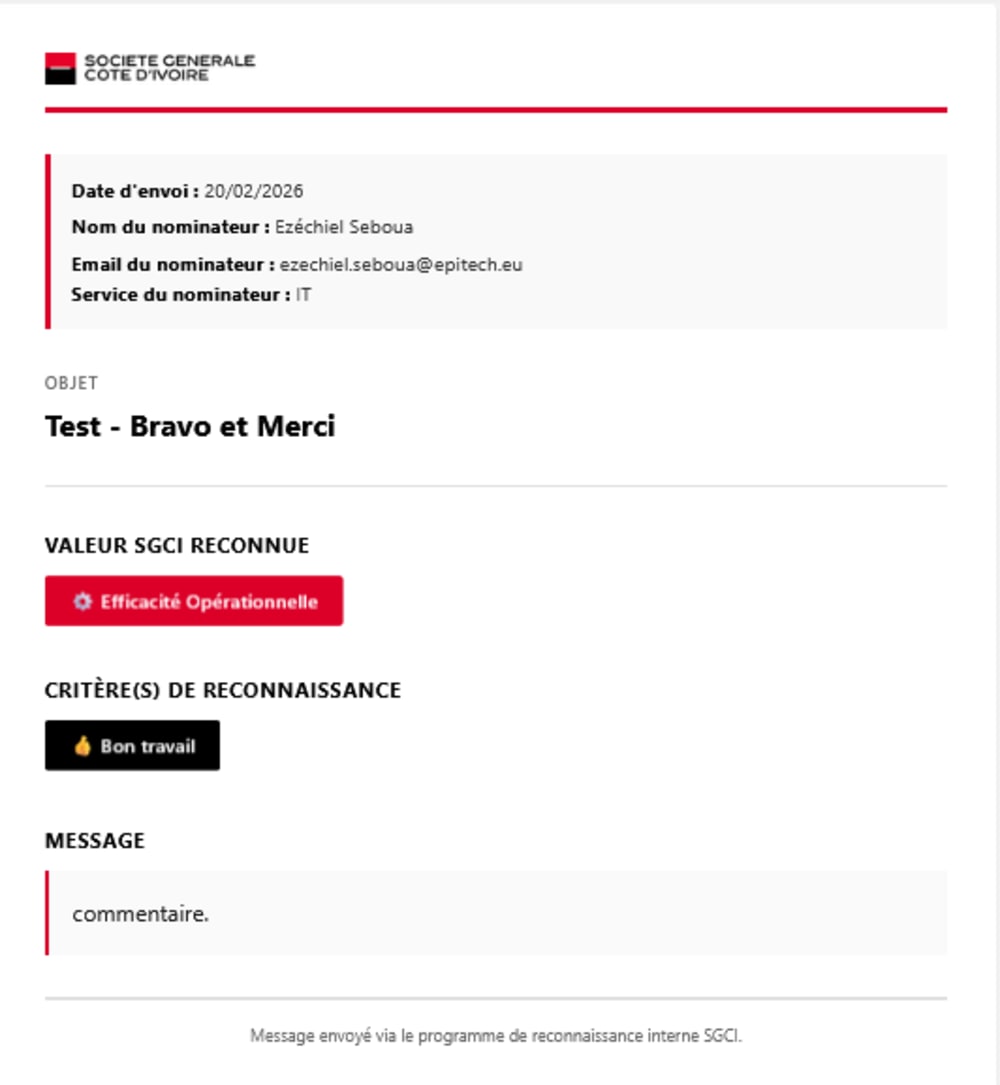
Microsoft Outlook Add-in built for Société Générale Côte d'Ivoire (SGCI) to foster internal employee recognition. Enables colleagues to congratulate or thank each other directly inside Outlook by selecting company values and criteria, with automatic Outlook profile pre-fill and instant submission to the HR API.

- Platform
- Desktop
- Role
- Developer — Mission for Société Générale Côte d'Ivoire
- Duration
- 2 months
- Year
- 2026
- Type
- Client project
- Status
- In production
Tech Stack
- Office.js
- JavaScript ES6+
- HTML5 / CSS3
- Webpack
- Babel
- Outlook Add-in
- REST API
Context
Société Générale Côte d'Ivoire wanted to encourage peer-to-peer recognition.
For recognition to feel effortless, it had to live where employees already spend their day—Microsoft Outlook—without opening another app.
The Challenge
Faire tenir un parcours de nomination complet dans le panneau étroit d'Outlook, et le faire fonctionner dans toutes les versions de la messagerie utilisées par la banque.
Approach
- 1 step
I built an Outlook Add-in with Office.js. Directly inside their inbox, employees congratulate or thank a colleague by choosing the company values and criteria demonstrated.
- 2 step
The sender's profile is automatically pre-filled from their Outlook account, and the nomination is sent straight to the HR REST API. Bundled with Webpack and Babel for broad compatibility across Outlook versions.
Key Features
Nomination sans quitter Outlook
Le formulaire s'ouvre dans le panneau de la messagerie.
Valeurs et critères de l'entreprise
Le collaborateur choisit ce que son collègue a incarné.
Profil rempli automatiquement
Nom, e-mail et service sont tirés du compte Outlook.
Results
Recognizing a colleague takes just seconds without leaving Outlook, and every nomination arrives cleanly structured for HR.
This add-in feeds directly into the Bravo & Merci HR evaluation platform built during the same engagement.
Développer pour un environnement imposé (Office.js) et penser une fonctionnalité là où les utilisateurs sont déjà, plutôt que de leur demander d'ouvrir un outil de plus.